
Boat builders Eritrea, Africa: The boats being built at Harena Boatyard
Australian company, Seachrome Marine International, in conducting a training workshop for 54 Eritrean nationals on Halib Island in the Red Sea, Eritrea (northeastern Africa bordered by Sudan, Ethiopia, and Djibouti).
The workshop concentrated on longline fishing gear fabrication and in the proper techniques of setting and hauling monofilament longline fishing gear using American-made (LindgrenPitman) longline equipment and Australian-designed (built in Eritrea) fibreglass fishing vessels.
The Masterfisherman also advised Sea Chrome Marine International on vessel parameters, gear design, and fisheries development strategies for a Red Sea fishery using monofilament longline equipment.
The workshop took place on a desert island, where a war-battered shipyard has been transformed into a productive facility, and a newly independent country has started to develop a new fishery. Sea Chrome Marine International is a well-known company in the region and has a history of being one of the largest producers of top quality fibreglass fishing vessels in Australia.
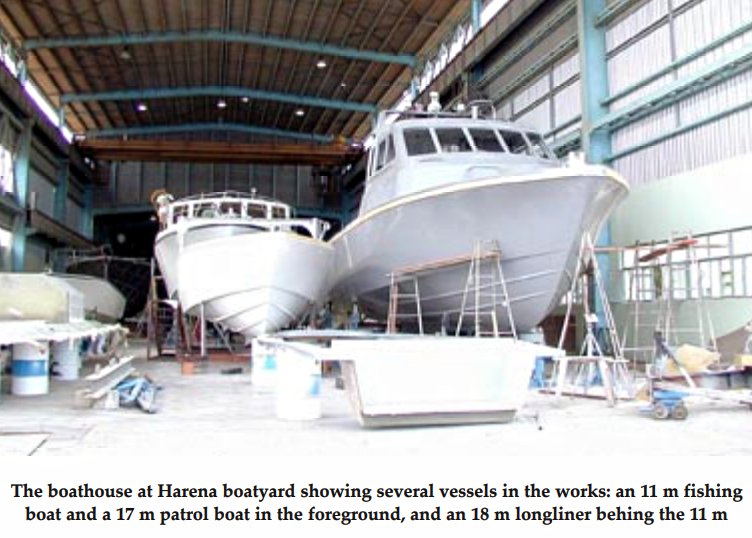
In the past, they produced up to 50 per cent of the commercial vessels operating in the West Australian rock lobster fishery. They branched out and began producing 18 and 20 m longline vessels for Pacific Island countries and territories.
complex in Assab. Two years ago the government of Japan built a fishing infrastructure for Eritrea that consists of a wharf with breakwater, a desalinisation plant, a flake ice maker, a block ice maker, chill rooms, processing rooms, two blast freezers, and a holding freezer.
The Ministry of Fisheries was using the facility to process fish caught by the local fleet, which consisted of mostly traditional Arabian style dhows (with Yemenese crew) using gill nets.
The Ministry of Fisheries purchases the fish (snappers, groupers, and jacks), processes them into frozen wrapped filets (pin bone in) and then stockpiles them in the holding freezer. It appeared that they had several tonnes of processed fish in store, but had not yet developed a steady market for their product.

The fish processing factory was under tight sanitary controls. Everyone entering had on gum boots and sanitary outerwear, and stepped into a foot wash before entering the cutting room. The workers were all properly attired, including hairnets. The cartons were all labelled with species, count, weight and date. The factory appeared to be ready for HACCP certification. The Ministry of Fisheries is hoping to export fish to EU markets.
The boats being built at Harena Boatyard will soon be fishing into this complex. One possibility for the future, considering the composition and relative abundance of the bottom fish catches, is the live reef fish trade in Asia. Nearby Dubai has regular airlinks to Singapore and Hong Kong. Even if the fishery in the Red Sea does not match other places, however, Eritrea is likely to become a major producer of boats for Africa and the Middle East.